I Went Looking for Escape. I Found Freedom.
My business partner Jen has a line about her own journey. She says she left teaching and coaching, only to discover that she was a teacher and a coach all along.
I've thought about that line a lot, because I recently had my own version of it. I went looking for escape. What I found was freedom. But it didn't look anything like I expected.
I recently spent ten days in complete silence. And I want to be honest about why I went. It wasn't because I suddenly became deeply spiritual. It wasn't because I was looking for some profound enlightenment. I went because my mind and body had reached their limit. I was running on empty, and some part of me knew that if I didn't stop on purpose, life would eventually stop me on its terms.
So I did what I tend to do. I threw myself into the deep end and figured out how to swim on the way down.
Honestly, It Felt Like Prison
I'm not going to romanticize those ten days.
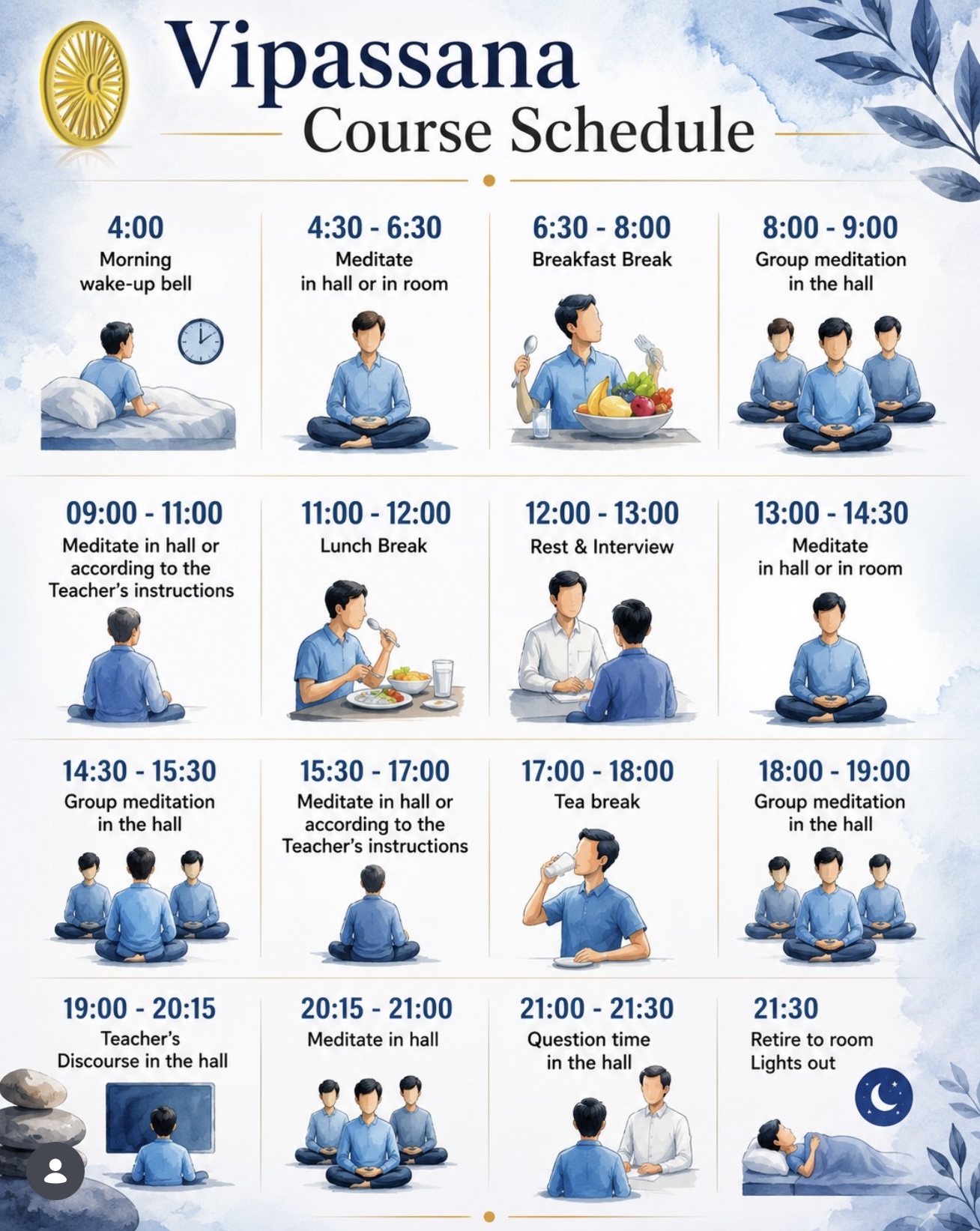
There was no phone. No books. No music. No journaling and no writing. No talking. No eye contact. Up at 4 a.m. to a bell, and then your entire day was governed by bells. Bell rings, get up. Bell rings, meditate. Bell rings, eat. Bell rings, meditate again. Hours of sitting, still, again and again.
Even the food was decided for you. Vegetarian. Breakfast at 6:30 am. Lunch at 11:00 am. At 5:00 p.m., tea and the option of a small piece of fruit. Then nothing. Your entire day was already decided before you woke up.
There were moments when I genuinely thought, prison sounds better. At least in prison you can talk. At least there's something to do. Here, there was nowhere to go except a narrow strip of concrete between two buildings, brutal heat and humidity, and your own mind. And there was no escaping that.
It was one of the hardest things I've ever done.
My Mind Was Louder Than Ever
For the first three days, the practice was incredibly simple. Observe your natural breath. That's it. And somehow, that was almost unbearable.
Because when you take away every distraction, every screen, every task, every conversation, every person, what's left? You. And your mind. Mine was loud. Very loud.
It ran straight to the worst-case scenario about everyone I love. It replayed conversations. It rehearsed the future. It questioned whether I was doing the practice correctly. It searched for problems to solve. I counted down the days like a child waiting for Christmas, and I started counting on day one.
I wanted to leave. Not once. Several times a day, every day.
Trying to settle my mind felt like trying to break a wild horse. Every time I thought I had it still for a moment, it bolted. And the more I fought it, the more exhausted I became.
Then My Body Started Talking Too
My body had its own opinion about the whole experience. For the first few days, movement was allowed. Then came the instruction to sit completely still. No shifting, no adjusting, no stretching your legs because they hurt. You sit, and you stay.
By the third day, my knees were on fire. My body hurt badly enough that falling asleep at night became difficult. Every minute could feel like an hour.
But somewhere around the middle of the retreat, something changed. The pain didn't magically disappear. I changed my relationship to it. I stopped fighting every sensation. And eventually, what had felt unbearable began to pass.
My body, like my mind, was learning something I had spent years resisting: a sensation can be uncomfortable without being an emergency.
That realization would become much more important than I knew at the time.
Just Stay One More Day
There was a metaphor the teacher used that helped me stay. He compared the ten days to surgery. You go in, something buried gets opened up, the process is uncomfortable, and eventually you're stitched back together and sent home. You don't climb off the operating table halfway through and say, "This is unpleasant, I'm leaving." You stay until the surgery is finished.
So that's what I did. I stopped trying to make it easier. I stopped asking whether I liked it. I stopped negotiating with myself about whether I should leave. I simply told myself: just stay one more day.
I went into the retreat as what I call a skeptimist. Skeptical and optimistic at the same time. Part of me thought I already understood a lot of this. I teach emotional resilience. I work with people under pressure. I spend my life talking about behavior, attention, stress, and capacity. So there was definitely an ego in me saying, okay, I get it, what else have you got?
At the same time, I had plenty of doubt. Would the technique actually work? Would I finish? Was I strong enough? Was any of this worth it?
And then, somewhere past the middle, something started to click. Not intellectually. Experientially.
Simple Doesn't Mean Easy
That may have been one of the most humbling parts. The technique itself is simple. It doesn't take ten days to understand it. It takes ten days to practice it, over and over, until you're no longer just thinking about the idea. You're experiencing it.
There was no complicated belief system I needed to adopt. No particular religion. No ritual I needed to believe in. It was stripped down to something remarkably universal. Sit. Observe. Notice what is happening. And don't label or react.
Simple. Brutally difficult. And incredibly powerful. Because knowing something intellectually and knowing it in your body are two very different things.
The Lesson I Didn't Expect
This was the part that really got me.
In previous meditation practices, I've occasionally experienced moments of profound stillness and peace. Blissful states where everything feels quiet, spacious, almost weightless. And when I experienced that during the retreat, my mind did what minds do. It wanted more. I want that again.
So the next time I sat down, I was looking for it. Where is it? Why isn't it happening? How do I get back there?
And suddenly I saw the trap. I wasn't suffering because the experience was gone. I was suffering because I wanted it back.
That distinction sounds small. It isn't. I had understood craving as a concept before. But sitting there, actually experiencing myself craving something pleasant that had already passed, I understood it differently. Wanting the pleasant experience and resisting the unpleasant one were two versions of the same thing. Both pulled me away from what was actually happening.
And I started seeing how often we do this in ordinary life. We think: I'll be happy when I get there. When I make more money. When the business takes off. When this problem is solved. When my body looks different. When the relationship changes. When I get the recognition. When I finally have enough.
And then, when something unpleasant happens, we do the opposite. I don't want this. Make it stop. Fix it. Escape it. Control it.
We spend enormous amounts of energy chasing what feels good and fighting what doesn't. And somewhere in the middle, we miss our actual lives.
The lesson wasn't that we shouldn't want anything. It was that wanting is not the same thing as living. You can enjoy something without needing to possess it forever. You can experience discomfort without immediately needing to escape it. You can let something beautiful happen without demanding that it happen again.
And maybe that's a different kind of freedom.
What I Came Home With
I came home lighter. Calmer. More patient with myself, and more patient with other people. More aware of my thoughts as they happen, instead of automatically being dragged around by them.
The world hadn't changed. My responsibilities hadn't disappeared. My problems hadn't magically solved themselves. I was still me. But there was more space between what happened and how I responded to it. And that space matters.
In our work, we talk about capacity. The internal capacity we draw from when pressure rises. I came home feeling like those internal tanks had been emptied completely and, somehow, made larger at the same time. Not because I had learned how to push harder, but because I had learned how much energy I was spending fighting what was already here.
I Went Looking for Escape
That's the part I keep coming back to. I went because I wanted to escape. From the noise. From the pressure. From my own thoughts. From the constant demands of life.
And instead, I discovered that I didn't actually need to escape my life. I needed to be able to be fully inside it without being consumed by everything happening around me. The freedom wasn't somewhere else. It was underneath the noise. I just couldn't hear it.
Ten days didn't change who I am. They reminded me who I am when I'm not constantly reacting.
And maybe that's my version of Jen's lesson. She left teaching and coaching only to discover that she was a teacher and a coach. I went looking for escape only to discover that freedom wasn't something I needed to find. It was something I needed to uncover.
You Don't Have to Wait Until You're Empty
I'm not telling you to go spend ten days in silence. Honestly, I'm not sure I would have recommended it to myself before I did it. But I do think there's something worth paying attention to.
If some part of you is saying, I can't keep going like this, listen before your body has to say it louder. You don't necessarily need ten days. You may need ten minutes. You may need a morning without your phone. A walk without a podcast. A conversation you keep avoiding. An hour where nobody needs anything from you. A place where you aren't performing, solving, producing, or responding.
Because sometimes resilience isn't about learning how to carry more. Sometimes it's about becoming quiet enough to notice how much you've been carrying that you were never meant to carry in the first place.
That's a big part of why this work matters to me. At The Academy of MotivAction®, we work with leaders, first responders, educators, and high-pressure teams on what happens when pressure becomes the environment rather than the exception.
Resilience isn't simply pushing harder. It's building the capacity to stay steady, clear, connected, and yourself when everything around you is asking you to react.
Because you don't need to escape your life to find freedom. Sometimes you just need enough silence to hear yourself again.
Learn more: http://academyofmotivaction.com
With gratitude to Vipassana Meditation taught by S.N. Goenka in the tradition of Sayagyi U Ba Khin.


